

The Hedge

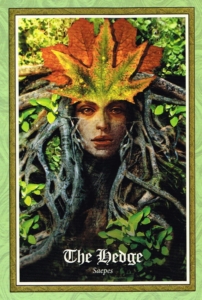 Saepes
Find and hold your own personal boundaries. We can’t be completely open with everyone. Having healthy boundaries is an act of positive self-love. Our plant allies can heal and nourish us. Plant a medicinal garden.
There is vervain,
There is rue,
Wormwood and the hedge,
We collect the earth, we collect the dew.
Wrap around my home,
This living protective shield,
Healing and defensive,
Only to love shall it yield.
Historically, a witch’s garden held many treasures, and when it included an herbal hedge, could also protect her from prying eyes. The term “hedgewitch” comes from these medicinal hedges, which many European witches grew. The hedges virtually enclosed the garden and provided privacy not just for the practitioner but for her visitors, as well.
A large part of Aradia’s gospel concerns the use of herbs for health, balance, and healing. Infections were fought with garlic, which has antibacterial properties; parasites were killed with wormwood; pain relieved with a potion of dittany and white willow bark (which contains the same active ingredient as aspirin). Streghe also used many ingredients from the “hedge” in their midwifery practices. Olive oil eased stretching skin and the birth canal; red clover cleared clots and the placenta; red raspberry leaves were a tonic for the uterus; and vervain was a restorative and astringent. Rue, with its triple-branching stem, could be seen as a symbol of the stregonerian pathway, as it was used during birth, in marriage ceremonies, and in funerals. Even the humble dandelion was used to increase urine production and as both a blood and a digestive tonic.
The darker side of herbalism, or hedgewitchery, is poison making, also a skill of the streghe. Most knew herbal concoctions that could harm-and the Romans, it is said, were masters not only of the art of poisoning but of the art of the counter poison, the antidote.
This substantial herbal knowledge had its origins in Egypt. It was further formalized in ancient Rome by physicians such as Dioscorides. However, because the Church saw the practice of medicine as an attempt by physicians to play God, it was discouraged, whilst those who were will were encouraged to pray and seek faith healing. Additionally, a concerted effort was made to suppress both the use of herbs for healing and science such as anatomy. Over time, much medicinal plant knowledge was lost. However, the oral tradition kept at least some of the herbalists’ craft alive, and by the mid-q500s there was a resurgence in the use of plants from the witch’s hedge.
There are no comments